
AI Isn't Eating Jobs. It's Printing Companies.
Why falling startup costs, shrinking teams, and instant distribution point to more businesses, more jobs, and faster growth, not less.
I keep hearing that AI is taking jobs.
Yes, it is. But that's half the story, and honestly the smaller half. The number that actually matters is how many new companies this technology spawns, because that's what ends up dictating employment. I've built products through two tech transitions, mobile and now AI, and inherited the results of a third. So this pattern isn't theory for me. I lived the "before" and I'm building inside the "after."
I wasn't even born when the PC revolution kicked off, but the math behind it still blows my mind. In 1980, launching a software company meant convincing customers to drop thousands on a physical box, haul it into an office, and manually train employees to use it. Adoption crawled across two decades, office by office. Yet that slow grind created Microsoft, Adobe, Autodesk, and Intuit. Entire industries popped up out of nowhere simply because computing pushed down the baseline cost of running a business.
By the time I entered the industry during the mobile shift, leverage had already spiked. Building CarInfo, a tiny team of six running on a monthly burn under $12,000 managed to reach tens of millions of users. The smartphone sitting in everyone's pocket handled distribution for us.
Now I'm running Hawk MarTech, operating right in the middle of the third wave. The underlying dynamic looks familiar, but the speed is jarring.
Same pattern, compressed timeline
Computers replaced manual calculations, but AI is taking over cognitive execution. Back then you bought hardware; today you ping an API endpoint or log into a cloud workspace. PC adoption took twenty years because humans had to learn how to speak software. AI adoption is happening in two or three because software finally learned to understand natural language.
Business creation curves across both eras show the same hockey-stick shape, just crammed into a much shorter timeline.
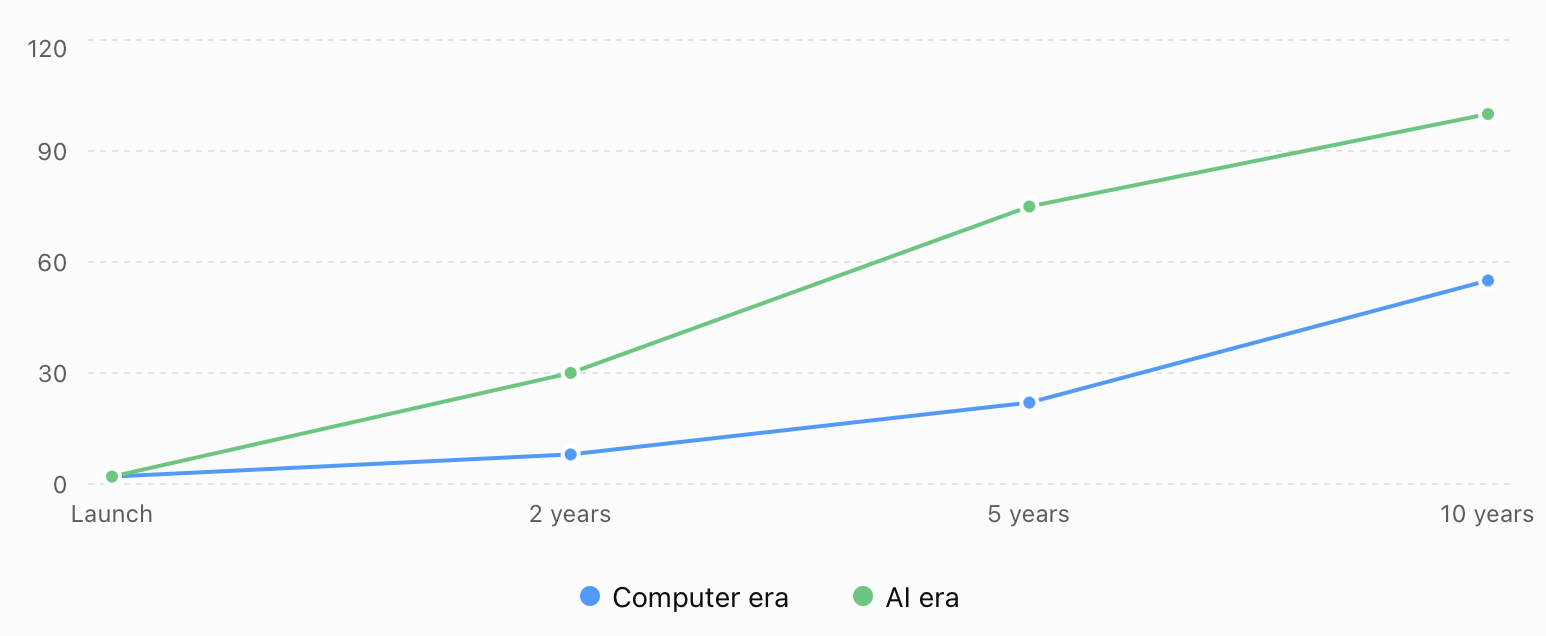
What took a decade on the desktop is happening in three years on LLMs. The friction between a product concept and a live production build has practically dissolved. At CarInfo, scaling up meant running hiring pipelines for QA and content operations; at Hawk, I just write a workflow or deploy an agent that handles those exact operational loops for a fraction of an engineer's salary.
| Metric | Computer era | AI era |
|---|---|---|
| Core input | Physical hardware, server racks, offices | Model weights, cloud infrastructure, prompt APIs |
| Upfront capital | Heavy | Minimal; bootstrappable from day one |
| Distribution | Retail boxes, local field sales, physical channels | Instant global reach via web and APIs |
| Launch headcount | 20-100 employees | 1-5 builders |
| Primary bottleneck | Physical and network infrastructure | Distribution, proprietary data, domain clarity |
Money stopped being the main barrier. Getting distribution and acquiring clean data are problems you solve after launch, not before.
The shrinking minimum viable company
The shift isn't about volume. The baseline headcount required to build something massive has collapsed.
A decade ago, hitting $10M in ARR required a full org chart: designers, copywriters, data analysts, customer support agents, and half a dozen backend engineers. Today, that math looks ancient. Lovable reached $100M ARR eight months post-launch with 45 people. Cursor hit $100M ARR in under two years with roughly 20. Midjourney built a nine-figure revenue machine with a team that fits at a single dinner table, without taking a dime of venture capital. Average SaaS companies generate around $130K in revenue per employee; these new teams are pulling in $2M+ per head.
Sure, these are outliers. But outliers re-anchor our baseline for what's possible. When Anthropic's Dario Amodei was asked when the first one-person billion-dollar company would arrive, his answer was "2026". Whether the date holds is secondary to the fact that serious founders now view that as a realistic trajectory. Where founders once needed six specialists just to push an MVP to production, now one person with clear domain context can ship it. Having built the expensive, headcount-heavy way in the past, I wouldn't dream of going back.
The bottleneck has migrated. In the PC era, you needed capital to hire engineers to build a product to sell to customers. Today, the chain is domain insight, distribution, and trust. Execution is getting cheap and commoditized. What remains scarce is knowing precisely what problem is worth solving and getting the solution in front of users. At Hawk, our project bottlenecks are almost never engineering bandwidth anymore. They are clarity on customer workflow.
This expansion doesn't cannibalize business; it multiplies who can start one. Long-term economic growth rarely comes from squeezing 5% more efficiency out of a legacy conglomerate. It comes from unlocking millions of new bets that couldn't exist previously.
What the next cohort actually looks like
It's easy to assume this next wave is just about "AI startups" selling model wrappers. A few will be, but history suggests the real volume lies elsewhere.
The PC era created software companies. The internet created platform networks. AI will yield hyper-leveraged domain companies, and most won't advertise themselves as AI firms at all. They will be regional logistics operators, niche law firms, specialized healthcare practices, and marketing agencies operating at 10x the output per person. Imagine a three-person legal team handling the caseload of a 30-partner firm, or a freight brokerage operating on massive margins because back-office processing is totally automated.
Incumbents won't necessarily be destroyed wholesale, but they will be forced to rebuild around automation, autonomous agents, and proprietary internal data: the specific operational moats competitors can't just copy with a prompt.
Why more companies mean more employment
So how does this resolve the job destruction narrative? If one worker does the work of six, shouldn't employment collapse?
Economic history points the opposite way. MIT economist David Autor found that 60% of US jobs in 2018 didn't even exist in 1940. Over 85% of employment growth across those eight decades came from entirely new occupations spawned by technological shifts. Nobody in 1940 was hiring cloud architects, growth marketers, or data scientists. My own career path across ixigo, Gojek, and my own ventures revolves around job titles that didn't exist when my parents started working.
When technology drastically lowers the unit cost of producing something, demand explodes, creating new categories of work. Desktop computers eliminated typing pools, but they birthed the global software industry. Net employment expanded, but because the new roles looked completely different from the old ones, the losses were immediate while the gains took time to become visible.
If AI enables millions of micro-enterprises rather than just leaner enterprise giants, total employment compounds. A 4-person business still buys accounting services, hires specialized contractors, uses infrastructure, and scales. Ten million lean companies employing five people each generates far more economic activity and employment than ten thousand legacy giants cutting headcount.
There is a real caveat here: Autor's data also shows automation eliminated roles twice as fast between 1980 and 2018 compared to the prior four decades, with new wealth leaning heavily toward higher-skilled labor. The macro transition will not be seamless, and adaptation is mandatory. Founders and workers who learn to use the new leverage capture the gains; those waiting for old workflows to return will get left behind.
The likely outcome
The PC era showed this: when building gets cheaper, the number of builders grows. AI is compressing that same cost collapse into a few years instead of a few decades. So yes, AI is taking jobs. It is also printing the companies that will create the next generation of them.