
An Ode to Stack Overflow: The Community That Taught a Generation to Think
Stack Overflow was not just a website. It was a place that taught us how to think in public. How to be precise. How to be wrong, and then better. We waited hours, sometimes days, for answers from strangers who cared enough to help. And when the answer came, it belonged to everyone.
I have been part of Stack Overflow for a long time. Long enough that my profile still feels like a piece of personal history rather than a line on a resume. Over the years, I crossed 11,000 reputation points, earned more than 180 badges, and, by conservative estimates, helped close to a million developers through answers, edits, and quiet improvements to existing posts. None of that felt transactional. It felt like belonging to a living, opinionated, sometimes pedantic, but deeply committed community of engineers trying to make the internet a little more correct.
What made Stack Overflow special was not just the answers. It was the process. You learned how to ask better questions. You learned that clarity mattered, that reproductions mattered, that context mattered. Posts were edited by strangers who cared enough to make your question readable. Answers were challenged, refined, and sometimes replaced entirely. You waited. Four hours. Sometimes four days. And when someone finally replied, there was a shared sense of discovery. We found it. Not you. Not me. We.
The rules were strict. Often frustrating. But they shaped a culture that rewarded precision and filtered noise. Over time, many of us internalized those standards. They made us better engineers, not just faster ones.
The Cliff Edge
For a long time, the decline of Stack Overflow was subtle. Activity softened gradually, almost imperceptibly, like a city emptying out after peak hours. Then, sometime after 2022, it fell off a cliff.
In March 2023, Stack Overflow saw roughly 87,000 questions. By December 2024, that number had collapsed to around 25,000. Fifteen years of growth erased in about eighteen months.
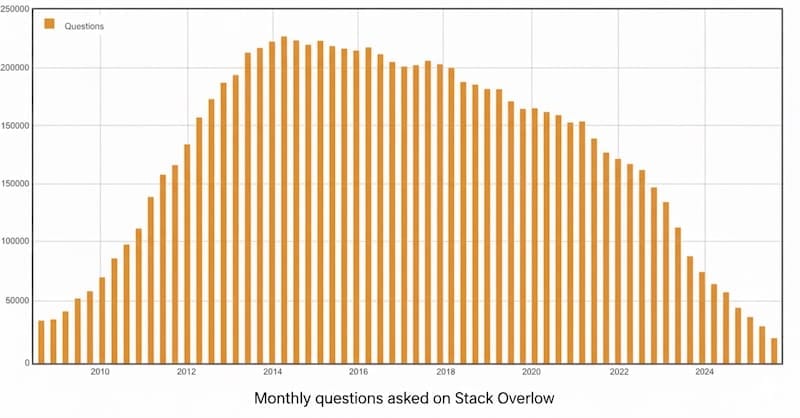
That number matters because it sends the site back to its earliest days. The last time Stack Overflow saw activity at this level was in mid‑2009, less than a year after launch. This was not a moderation tweak or a temporary low, it was a structural change in how developers seek help.
Since the launch of ChatGPT in November 2022, developers have largely stopped asking questions in public. They ask them in private, inside chat windows that answer instantly (and forget just as quickly).
The Twist
At first glance, this looks like a familiar internet story. Community fades, traffic collapses, revenue follows. Except that is not what happened.
Here is the twist. While the community evaporated, Stack Overflow’s revenue actually went up. The company is reportedly pulling in over 115 million dollars a year. The reason is simple. They stopped selling ads to humans and started selling humans to machines.
As developers stopped asking questions, companies like OpenAI and Google became desperate for high‑quality, well‑structured answers to train their models. Stack Overflow pivoted. It took the 58 million questions we wrote, debated, edited, and refined for free and licensed them as one of the most valuable training datasets on the internet. The most valuable asset was no more the active community. It was the archive we left behind.
The Irony
When you ask a question on Stack Overflow, the answer becomes a public artifact. A junior developer three years from now can still find it. When you ask an AI, the answer is ephemeral. It exists for you for a few seconds and then disappears. We are trading a public library for a private whisper. We are no longer building a shared knowledge base. We are simply consuming one.
There is a bitter irony here.
The only reason these models can fix your code today is because people like me spent more than a decade answering questions for internet points. They were trained on our pedantry, our debates, our edits, and our insistence on correctness. They stand on the shoulders of reputation systems and gold badges that once rewarded contribution.
We built the dataset that replaced us. We are no longer the customers. We are the product, frozen in amber and sold by the gigabyte.
The Trade‑Off
I used to spend hours crafting the perfect minimal, reproducible example to post on Stack Overflow to not get downvoted. Now I paste a messy error log into ChatGPT or Claude and say, fix this.
It is faster. It is easier. And it is safer. A bot does not judge you for not reading the documentation. It does not close your question or mark it as off‑topic.
But here is what keeps me bothering: the knowledge freeze.
AI models are trained on the past. Your answers from 2016 help ChatGPT write React code today. But when React 20 ships next year, where does the new training data come from if everyone asks the AI and no one asks in public?
We are burning the furniture to keep the house warm. By moving from a public square to a private chat window, we have stopped documenting the cutting edge. The AI knows everything we did, but it has no reliable way to learn what we are doing now.
What Remains
Even now, I still type stackoverflow.com directly into my browser from time to time. Not because I expect new answers, but out of habit. Muscle memory. Nostalgia. I miss the feeling of asking a question in public and trusting that another human, somewhere else in the world, would take the time to help.
Stack Overflow itself seems to recognize this transition. Its leadership speaks of a new era that blends community knowledge with AI‑assisted workflows. Perhaps that future will work. Perhaps the platform will survive, transformed into something adjacent rather than central.
But whatever comes next, the old Stack Overflow mattered. It taught a generation of developers how to think, not just how to code. It showed us that generosity scaled, that strangers could collaborate at internet scale, and that patience was sometimes the price of truth.
If this really is the end of that era, it deserves acknowledgment. Not as a failure, but as a foundation.
And for that, I remain grateful.